
Accounting Treatment for Expired Goods in Inventory
Expired goods can create a direct financial loss for a business. Proper identification, valuation, accounting, and disposal are therefore important parts of effective inventory management.
At the same time, businesses should identify slow-moving and surplus inventory before products reach their expiry period. For commercially usable inventory, Barter in India can provide an alternative approach to utilizing business resources through structured exchanges.
Identifying and Valuing Expired Inventory
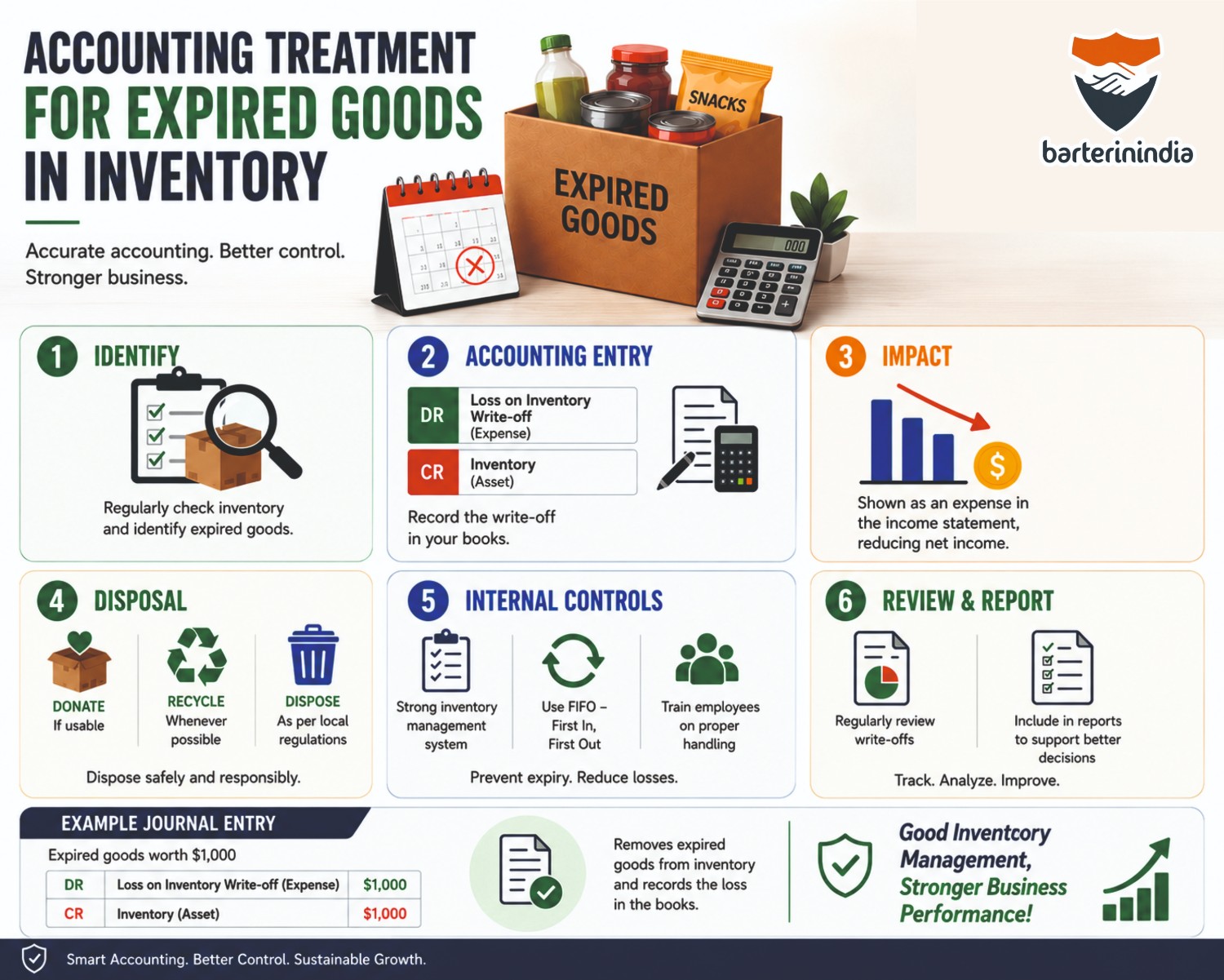
Businesses should conduct regular physical inventory checks to identify expired and near-expiry products. Appropriate costing methods such as FIFO, LIFO, or Average Cost can be used to determine the value of inventory according to the applicable accounting practices.
Regular monitoring can help businesses identify products that are approaching expiry and take appropriate action while the inventory is still commercially usable.
A Barter Company in India may help businesses identify suitable opportunities for eligible surplus inventory before it becomes expired or unusable.
Accounting Entry for Expired Inventory
The basic accounting treatment for expired inventory is:
Debit: Loss on Inventory Write-off
Credit: Inventory
This removes the value of expired goods from the inventory records and recognizes the corresponding loss as an expense.
The exact accounting treatment may vary depending on the applicable accounting standards and circumstances. Businesses should consult a qualified accounting professional for specific accounting or tax requirements.
Impact of Expired Inventory on Business
When inventory expires and is written off, the loss is recognized as an expense for the relevant accounting period. This can reduce the business’s net income.
For this reason, businesses should not wait until inventory becomes unusable. Regular stock reviews, FIFO rotation, expiry-date monitoring, and accurate inventory records can help identify slow-moving stock earlier.
For businesses with commercially usable surplus resources, B2B Barter in India can be considered as one possible way to exchange eligible inventory or business resources for other requirements.
Proper Disposal of Expired Goods
Expired products should be handled and disposed of responsibly according to their nature and applicable regulations.
Possible approaches may include:
- Donation where legally and practically appropriate
- Recycling
- Responsible waste disposal
- Following applicable regulations for specific products
- Maintaining proper internal records
It is important to distinguish between expired inventory and usable surplus inventory. Barter is generally relevant to commercially usable products, services, or resources rather than goods that have already expired.
Preventing Inventory Expiry
Strong inventory controls can help businesses reduce losses caused by expired products.
Businesses can focus on:
- Regular inventory checks
- FIFO-based stock rotation
- Expiry-date monitoring
- Stock-level management
- Identifying slow-moving products
- Employee training
- Regular management reporting
Businesses with eligible surplus inventory can also consider a Barter Agency in India when looking for structured business exchange opportunities.
How Barter in India Can Support Surplus Inventory
Surplus inventory does not always mean unusable inventory. Products that are still commercially valuable may potentially be exchanged for other business requirements.
Through Barter in India, businesses can connect with other companies and consider exchanges involving eligible products, services, promotional resources, advertising, or other commercial requirements.
A structured Barter Exchange in India can provide a framework for business-to-business exchanges while helping companies make better use of available resources.
Barter and Marketing Requirements
Barter can also be relevant to advertising and promotional requirements.
Where commercially suitable, businesses may exchange eligible products or services for advertising, promotional products, media opportunities, or other marketing-related requirements.
Barter Marketing Services can therefore form part of a broader strategy for utilizing surplus resources while addressing business and promotional needs.
The Bottom Line
Expired inventory needs to be properly identified, recorded, and disposed of. The basic accounting entry recognizes the inventory write-off as a loss and removes the expired goods from inventory records.
However, businesses can focus on identifying slow-moving and surplus inventory before it expires. Where the inventory remains commercially usable, Barter in India can provide another potential route for utilizing available business resources through structured B2B exchanges.
Whether a business is managing surplus products, promotional requirements, advertising needs, or other commercial resources, a structured barter approach can help connect available resources with relevant business requirements.
Interested in exploring barter for your business? Connect with Barter in India to learn more about B2B barter and business exchange solutions in India.